
A delicate French accent conceals a healthy predisposition for travel and discovery.
Victoria Ferraro Vidal's story is one that people love to hear, because it is rich in everything that can be gained by moving from one place to another in search of one's place in the world.
So she arrived in Italy and settled with her family in Bassano del Grappa, where she learned a new language and fell madly in love with ceramics.
From France to Bassano del Grappa, it seems like quite a change. What was your journey like?
I was born in Provence, in a small village unknown to anyone except the French who pass through it on their way to the sea. It is called Montélimar (Drôme Provençale) and my family still lives there.
I have actually lived in several cities in France, from Paris to Marseille, Nîmes, and Lyon. my husband and I wanted to travel to discover new places and find one that we liked more than the others.
In 2017, we decided to take advantage of a job opportunity that came up for my husband in Italy, his country of origin even though he was born in France, so we chose to move there with our two little girls to immerse ourselves in a new culture to which we have always felt connected.

You write content in French and Italian on your social media. What helped you familiarize yourself with a new language?
For a year, I studied thanks to Gruppo 8 Marzo Onlus, a non-profit association that helps foreign women settle in.
I attended classes twice a week, but having the girls was also helpful because, in some ways, you have to make do, even if it's just to talk to the teachers.
I threw myself into it, so wherever I go, I make myself understood because I really enjoy talking.
How did your love of ceramics come about?
I started by chance, taking my girls to a class. I said to myself, "I'd like to try, " so I gave myself a Christmas present and started.
From the basic course, I took others, until I realized I wanted to learn much more. My teacher invited me to attend a four-month course, during which the workshop was open almost every day, practically all day long. From that moment on, I never stopped.
The course at the Art School in Nove—known worldwide as the "City of Ceramics"—and the internship at a local artisan company were also very important.
At the end of the course, I rented a room and turned it into my workshop.

What are the tools of the trade and how does the creative process work?
To work, I need water, a potter's wheel, an apron, and my hands. I never start with a drawing; I just dive in and, if it works, great, otherwise I start over. But I really like to write: I make notes about what I need to do and how much clay I need, or what the object should look like in the end and its dimensions.
Is the workshop open to the public?
No, but I often participate in markets. During lockdown, I launched my website, and it's working well, but I like interacting with people.
I like explaining the items on display to people and letting them touch them, because ceramics need to be touched: you need to feel their weight and texture. With a cup, for example, you need to see if you feel comfortable with the shape of the handle. Touch is very important.

Your works have an intense and well-defined personality, with a strong feminine component. What should we read between the lines?
Feminism is a very important issue for me: I am a woman, I am the mother of two daughters, and I have found that my field is heavily male-dominated, perhaps a little "old-fashioned."
The feminist struggle and sisterhood are two fundamental issues for me, which is why they find their way into my work every day.
Being a woman in today's world—in an absolute sense, but also in the specific field of ceramics—is not easy, which is why I want to teach my girls from now on that if they want to do something, they can do it; women can do anything. If we don't believe it, however, no one else will do it for us.
When you enter your workshop, what are your favorite objects to make?
Vases and cups. The former because I really love plants and flowers; in fact, my house is full of them. I love cups, both with and without handles, even though I've learned that people prefer them with handles.
But when you think about it, a cup is a cylinder, and as long as you don't add a handle, it can hold anything. I prefer not to name objects and let my customers' creativity assign them a role.

Victoria's story teaches us that facing life without too many fears and preconceptions can help us to really get to know ourselves, to discover passions that were already within us, just waiting to find the time and place to explode.

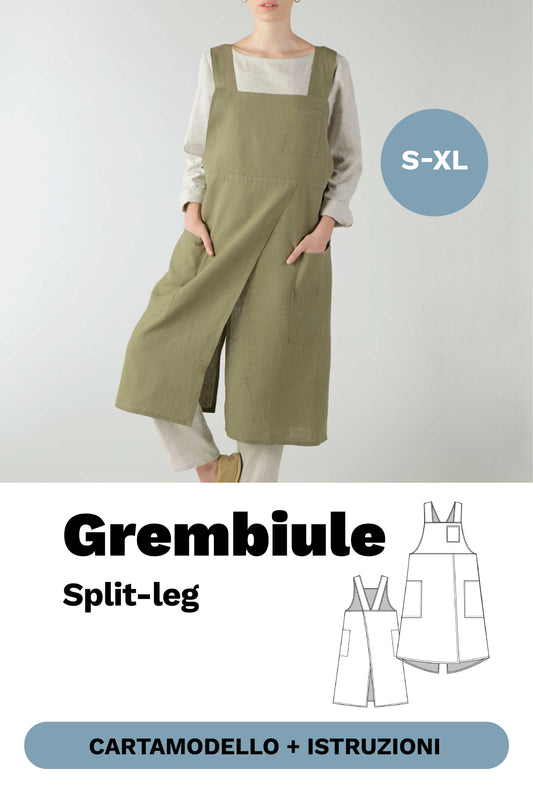
Photo by Ohlalaceramica - Victoria wears the Split-leg Apron model in Olive
Where you can follow Victoria.
In her online shop - at
On her social media channels, to stay up to date.
IG - https://www.instagram.com/ohlalaceramica/
FB - https://www.facebook.com/Ohlala-Ceramica-112157820973657