
When we saw what Claudia Agnolon had created with our creative box first, and then with our dungarees, we were so fascinated that we wanted to know everything about the technique she had used. That intense blue and the natural patterns on the fabric reminded us how much we lovecraftsmanship and creativity, which always surprises us in unexpected ways.

These prints are made using a technique somewhat reminiscent of photography, called cyanotype. This technique is ideal for decorating paper or fabrics, which must be strictly natural, and produces beautiful works of art that remind us how man and nature, together, can create wonderful things.
But let's let Claudia tell you more about it in detail, so that you can learn more about what it is with us and, who knows, let yourself be carried away by her creative energy!
The cyanotype technique
To those who have never heard of it, cyanotype seems to be halfway between a magical art and a very difficult scientific process. Can you tell us about your training and what led you to take up this art form?
I don't have any specific training in photography or art. I studied something completely different abroad, where I grew up. My passion for cyanotype printing arose somewhat by chance in recent years. While browsing Instagram, I came across these beautiful blue prints and was fascinated by them. From that moment on, I started looking for information on what exactly they were and how they were created. So I am self-taught.

Could you explain in simple terms what cyanotype is and how these incredible prints are made?
Cyanotype isan ancient printing technique that dates back to 1842. Two specific iron salts are used to create two separate solutions which, when mixed together in equal quantities, create a yellow/green photosensitive solution that is applied to the surface to be printed, such as a sheet of paper, in an environment protected from light. sunlight. The sheet must be left to dry. Once dry, the object to be printed is placed on top of the emulsified sheet and exposed to sunlight. For exposure, I use a frame with glass so that the flowers and leaves do not move while they are outdoors. The exposure time can vary greatly depending on weather conditions. You will then see the color of the emulsion change from yellow/green to gray/brown. Did you think it would turn blue right away? No, at this point the print is not yet complete and, like a photograph, it needs to be developed. Simple water is used for development. This is where the magic happens. As soon as the sheet is immersed in water, you will notice the color of the emulsion, which has been exposed to the sun's rays, change to blue. The unexposed part will be washed away by the water and reveal the color of the support. White if we have used a white sheet. The sheet should then be left to dry in the shade, and within 24 hours the print will reach its final blue color.

Tools and preparation
Are specific materials and tools required? Are they easy to find?
It is essential to obtain iron salts to produce the photosensitive solution, which can be found quite easily on various websites that sell them. The rest of the tools can be found at home. A brush, a photo frame, clothes pegs. You don't need to buy leaves and flowers from a florist; if you don't have a garden, you can find them along the sides of roads. Give it a try, you will make amazing discoveries. Things you have never noticed before. Cyanotype changes the way you see the nature around you.

Is this something anyone can try, or does it require specific training?
No specific preparation is necessary; it is accessible to everyone, of all ages. I recommend that those who have the opportunity participate in workshops where they can be introduced to this technique. I myself am offering workshops in my area to introduce people to cyanotype. Participants in my courses are always amazed at how magical this technique is and come away enthusiastic. I stay in touch with many of them and we exchange opinions and experiences on the results obtained.
Cyanotype and nature
Most of your creations reproduce motifs that recall nature (flowers, plants): is this a particular passion of yours, or is nature the subject that lends itself best to being immortalized with this technique?
Nature is very fascinating and lends itself very well to being reproduced with this technique, plus it is accessible to everyone. It offers a wide variety of different shapes and transparencies. Prints made with plants are considered unique and unrepeatable. Of course, others may print the same flower that I have printed, a lily of the valley, a wild carrot flower, a sprig of nandina, but it will never be identical to mine. In my opinion, this is what makes the use of plants in cyanotype so special.
Anna Atkins is considered the first woman to have published the first book with images (seaweed reproduced with cyanotype) in 1843. 180 years after the publication of this book, I like to think that every cyanotype produced with nature is a memory, a tribute to her.
What types of media can this technique be applied to? What requirements must a fabric have for the print to turn out well?
Cyanotype can be applied to virtually any medium that absorbs the solution. In the case of fabrics, it is essential that they are of natural origin, such as cotton, linen, silk, or hemp.
It can also be applied to non-absorbent materials such as glass. In this case, an additional ingredient is added to ensure that the solution adheres to the material.

Feeling inspired?
You can find more of Claudia's creations on her social media accounts: Instagram@bottegadelsoleblu Facebook Claudia Agnolon.
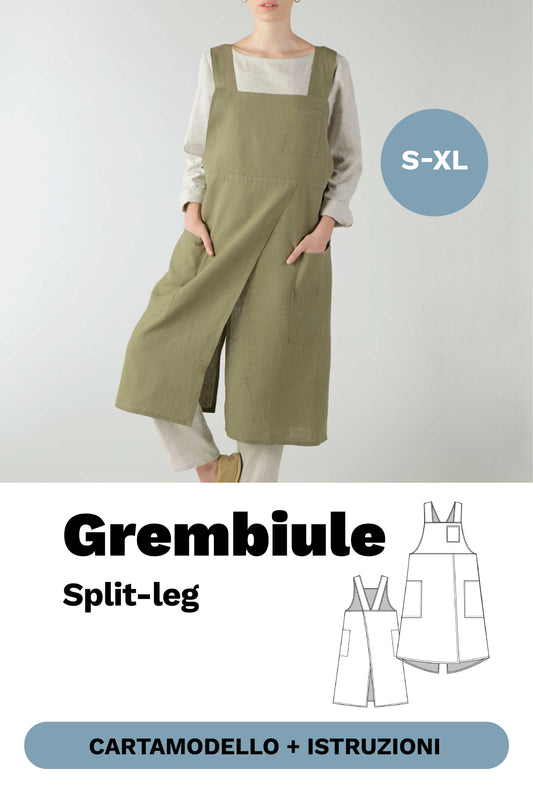
If this story has inspired your creative streak, purchase our creative box and, if you like, show us the results! If you know how to sew, you can also make the Roundemnck crossover apron from our digitalpattern, and then personalize it with this technique. If, on the other hand, you prefer to let your creativity run wild by wearing one of our garments or, why not, experimenting with one of our garments, visit our shop.
As you will have understood by now, what matters to us is that creativity finds its way into the lives of those who follow us!